Your senator doesn't know you exist
USC's Student Government codes require senators to assess constituent needs 'in good faith.' There is no definition of what that means, no enforcement mechanism, and no consequence for ignoring it entirely. Most peer universities have the same problem. A few don't.
By Common Sense Carolina | Feb 13, 2026 | 12 min read
There are roughly 38,000 students at the University of South Carolina’s Columbia campus, and fifty senators represent them. That works out to one senator per 760 students. Ask any of those 760 who their senator is, and most will draw a blank — ask the senator what their constituents actually care about, and you will get the same result.
The Student Government Codes say senators have a duty to “make an effort in good faith to assess the needs of their constituents” (SS2-2-10(A)(5)), and that is the entire requirement. “In good faith” is never defined. No method is specified — no office hours, no surveys, no town halls, no emails. There is no reporting requirement and no enforcement mechanism. A senator can win election, attend meetings, vote on legislation affecting thousands of students, and never once ask a single constituent what they think. Nothing in the codes stops them.
“In good faith” is doing a remarkable amount of heavy lifting for a body that controls mandatory student fees, passes codes with quasi-legal authority, and claims to speak for the entire student body. A subjective, unverifiable standard might as well not exist at all.
How other universities handle this
USC is not uniquely bad here — most student governments across the SEC run on similar vagueness around constituent engagement — but a handful of institutions have moved past the honor system.
At the University of Tennessee at Knoxville, Graduate Student Senate members are required to maintain an active email for constituent communication, hold meetings with graduate students in their college or department, notify constituents of bills and amendments before the Senate votes, and actively represent the viewpoints of their program. These are not suggestions. They are formal obligations codified in the GSS bylaws, and senators who fail to meet them face removal.
Southern Illinois University Carbondale requires undergraduate senators to hold at least one constituency meeting per month and log two office hours per week, with the university defining what counts as office hours (any business conducted on behalf of student government, including committee work) and tracking compliance.
Over at UAB, graduate senators must forward monthly minutes and legislation to students in their college, publicize travel grants and activities, and keep open communication channels for constituent input — and senators are evaluated on how well they actually keep people informed.
Stanford takes a different approach entirely by publishing a full external directory of every senator, complete with committee assignments and working group participation. Students can see exactly who represents them and what that person is doing, because meeting minutes, attendance records, and the legislative record are all public.
At USC, the Student Government website lists senators, but the information a student would actually need — contact details, attendance records, outreach reports, committee assignments — is buried in a labyrinth of OneDrive and Google Drive files, nested folders, and dead-end links. There is no way for a student to look up who represents their college and reach that person in three clicks. The codes do not require any of this to be accessible.
The access problem
The absence of formal constituent engagement does not mean no engagement happens — it means engagement runs through informal channels, and informal channels favor students who are already connected. Got a senator in your fraternity or sorority? You have a line to Student Government. Serve on a student org board that interacts with SG, or know someone who knows someone? Same deal.
But if you are a first-generation student who has never heard of Student Government, nobody is reaching out to you. Commuter students who drive to campus for class and drive home for work are not getting surveyed in their car. International students unfamiliar with American student governance structures have no obvious entry point, and a student with social anxiety is not going to cold-message a stranger on Instagram to share their opinion on a fee allocation.
The result is two tiers of representation. Connected students get heard. Everyone else gets represented in theory.
This is not to say senators have bad intentions or are malicious — most of them ran because they cared and were going unheard. But people naturally listen to whoever is already in the room, and without a system that pushes senators to seek out input from all constituents, not just the ones they already know, representation defaults to proximity. Students closest to power get served. The rest get forgotten.
The public comment gap
City councils do it. State legislatures do it. Congress does it. Corporate boards, faculty senates, even HOAs do it. A formal public comment period where constituents can address their representatives directly is one of the most basic features of representative governance.
USC’s Student Senate codes include no such thing. The constitution mandates that “all sessions of the Student Senate shall be open to the public” (Article III, SS17), but that only guarantees the right to watch. A student can sit in the gallery and observe, but they cannot speak — even if a senator wants them to. Under Robert’s Rules of Order, the entire body must vote to suspend the rules before a non-member can address the Senate. There is no open forum, no sign-up sheet, no three-minute window where a student can walk up to a microphone and say what matters to them.
Several peer universities handle this differently. UT Dallas holds a public comment period at every Senate meeting where any student can speak for up to three minutes with advance registration. Wichita State does the same, with same-day registration closing at 7:30 PM. Bowling Green State includes “Lobby Time” as the fifth item on every General Assembly agenda. These are not radical experiments — they are standard democratic practice applied to student governance.
Without public comment at USC, the only students shaping Senate deliberations are the ones who already have a senator’s ear, and everyone else watches from the gallery, assuming they know the meetings exist at all.
The election problem
Constituent representation assumes constituents chose their representative, and at USC, that assumption is getting harder to defend.
The 2024 Student Government executive elections were mostly uncontested. When candidates run unopposed, voters have no meaningful choice and turnout collapses, which means senators win with tiny fractions of their constituencies behind them — sometimes elected by friends and organization members alone.
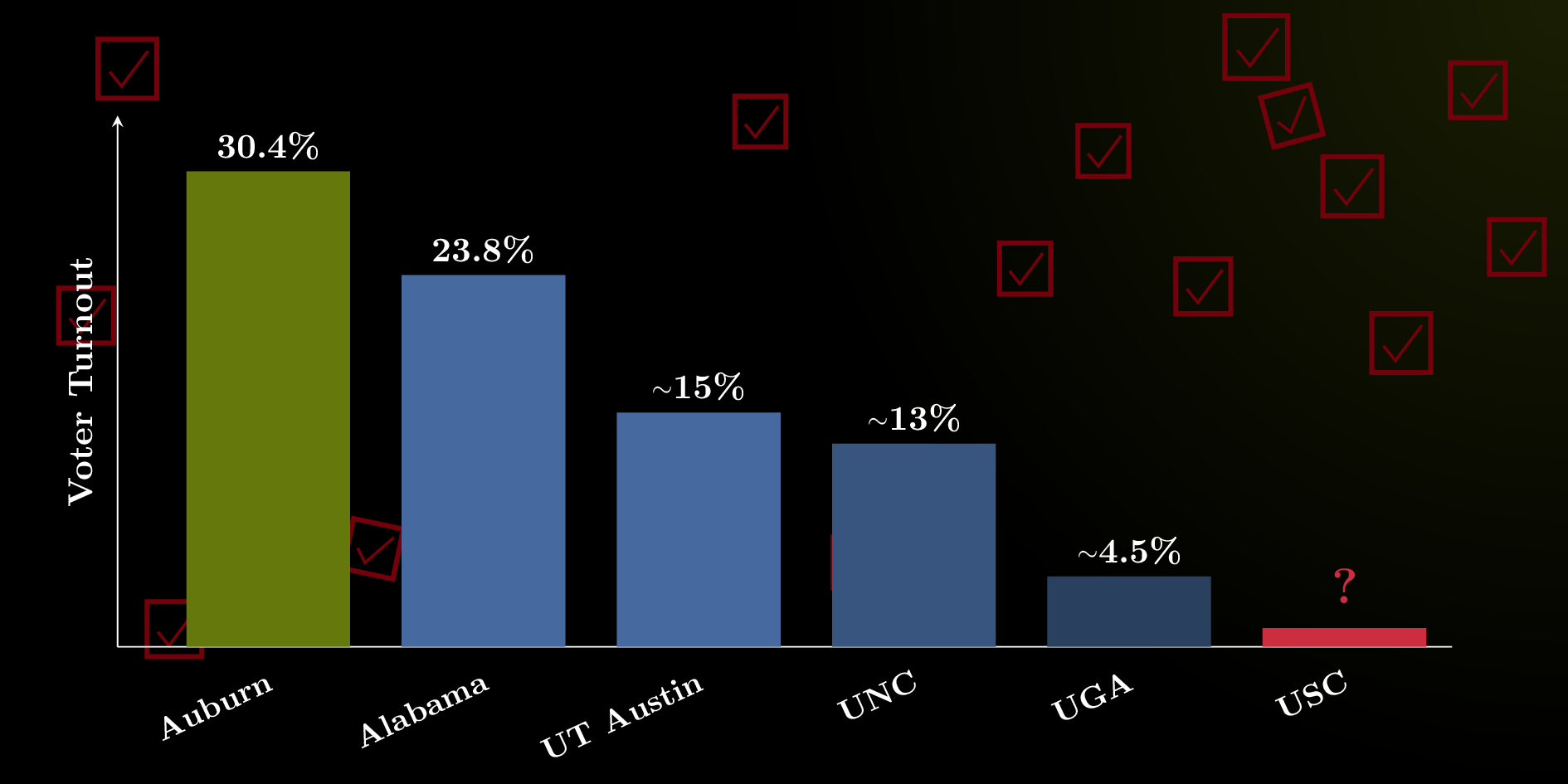
USC is not alone in this. The University of Texas at Austin has seen under 25% turnout in each of the last ten years, bottoming out at 4.3% in 2022. But some schools do better — Auburn’s 2025 SGA election drew 30.44% turnout, with nearly 10,000 students voting out of 32,756 eligible.
Auburn students do not inherently care more about student government. The difference is structural. Schools with competitive races, visible campaigns, and student governments that demonstrably affect student life generate participation, while schools where the outcome feels predetermined, or irrelevant, do not.
When senators are elected by a sliver of the student body and then face no obligation to communicate with the rest of it, calling them “representatives” is generous.
The referendum vacuum
The USC Student Government Constitution grants students the power to propose constitutional amendments through petition. Article VI, SS1 requires signatures from 7% of enrolled students, roughly 2,660 people. That right has never been successfully exercised in modern USC history.
The reason is simple. The Student Government Codes contain no procedures for actually doing it. How do you obtain official petition forms? How are signatures collected and verified? What timeline governs the process? Who validates that the threshold has been met? How are referendum questions drafted, and when does the vote happen? None of these questions have answers in the codes. The constitutional right exists on paper, but the operational machinery to exercise it does not.
That leaves the Senate with monopoly control over constitutional change. Students who want to restructure representation, expand voting rights, or create new accountability mechanisms can only do so through the very body those changes would constrain — a textbook structural conflict of interest.
Other universities have figured this out. The University of Virginia provides official petition forms through its University Board of Elections and encourages petitioners to submit language to the General Counsel for legal review before collecting signatures. Purdue Northwest uses a dual-threshold system in which petitions need either a majority of students who voted in the last election or 20% of the student body, and a 14-day public comment period is required before any vote. Boston College requires 1,000 signatures with verified student IDs and prohibits off-campus sponsorship of referenda.
Ohio State has codified digital petition procedures, letting students sign from their dorm rooms instead of hunting down petitioners in person, while Wisconsin-Oshkosh gives petitioners a 48-hour feedback loop to revise language rejected on technical grounds, so a fixable drafting error does not kill a petition outright.
USC has none of this. The constitutional right to petition is real. The ability to use it is not.
What the fix looks like
None of these problems require reinventing student governance. Every fix described below already exists at a peer institution somewhere.
First, the codes should require senators to maintain a publicly accessible constituent feedback channel — an email, an online form, something a student can find and use without knowing the senator personally. Contact information for every senator should be published on the Student Government website and searchable by college.
Second, senators should submit a semester outreach report summarizing how many constituent interactions they had, what themes came up, and how that input informed their votes. Make these reports public. Senators who fail to file face probation.
Third, add a public comment period to every Senate session — three minutes per speaker, advance registration with same-day sign-ups permitted, placed early in the agenda. Let the Speaker control the queue. It takes 15 to 20 minutes and transforms the Senate from a body that deliberates about students into one that deliberates with them.
Fourth, codify referendum procedures. Official petition forms, signature verification, timelines, pre-clearance for legal review, and a defined path from petition to ballot. The constitutional right already exists. The codes just need to make it usable.
Fifth, create committee observer seats for non-senator students. Observers would attend meetings, participate in discussions, and learn governance without voting — functioning as a recruitment pipeline, a diversity mechanism, and a bridge between Student Government and the students it claims to represent.
These are not radical proposals. They are the baseline of functional representative governance. USC’s Student Government has the structure of a democratic body and the accountability mechanisms of a social club. The codes say the right words. Nothing enforces them.
Thirty-eight thousand students pay mandatory fees into this institution, and most have never spoken to their senator. Most do not know who their senator is. Right now, nothing in the codes requires that to change.