The legislature is using a hostile takeover of higher education
South Carolina provides 13% of USC's budget yet elects 80% of its governing board. Students and families fund more than half of operating revenue, yet have no representation.
Originally published in The Daily Gamecock
South Carolina provides 13% of USC’s Columbia campus budget. Tuition and fees cover more than 50%. State funding remains nearly 40% below 2008 levels, adjusted for inflation, despite a full economic recovery.
USC’s own government relations office puts it plainly — public higher education in South Carolina is “state assisted rather than state funded.”
And yet the General Assembly governs this university like it owns the place.
The legislature chooses 16 of USC’s 20 Board of Trustees members and the governor appoints one more. That leaves three ex officio seats to actually represent the university’s interests.
Students, families and federal research agencies fund nearly 87% of this university’s operations, yet none of them have any representation on the board.
For 8 years now, South Carolina has held in-state undergraduate tuition flat at $6,344 per semester, enabled by state tuition mitigation funds. That sounds generous until you learn the state provided $65 million for mitigation in 2025-2026 when universities said they needed $130 million.
University presidents have publicly called the freeze “not sustainable.” The state is buying a talking point on the cheap, and students will eventually pay the difference.
Pending bills S.368 and H.3927, both in committee with Republican supermajorities in each chamber, would require DEI compliance audits of every public university at least once every four years. The bills define “DEI” so broadly that compliance reviews could reach student support services, university bookstores and academic programs that study inequality.
If the State Auditor finds a violation, the institution gets 180 days to cure it. Fail, and the State Fiscal Accountability Authority “may direct the State Treasurer to withhold all future distributions until the violation is cured.”
That is the same SFAA that approved $350 million in Williams-Brice Stadium renovation bonds last August. Both bills explicitly reference President Trump’s Executive Order 14173.
All future distributions. For a definition of DEI that could cover a bookstore display.
None of this means the state has no legitimate oversight role. The December 2024 Legislative Audit Council report on USC’s Office of Economic Engagement proved why it does.
The LAC found $1.7 million in questionable transactions from a $6 million federal COVID relief grant. Two Columbia computer labs funded by the grant never opened to the public, accounting for $635,600.
A $400,000 marketing contract went to a PR firm whose former CEO was a personal friend of OEE leadership. In 2023 the firm produced seven deliverables and two press releases.
Eight employees signed federal time-and-effort certifications for grant work they told auditors they never performed. Someone bought Apple Watches for Palmetto College IT staff with computer lab money. The office ran over budget in five of six years studied.
That is real waste, and USC deserved the scrutiny.
President Amiridis called the expenditures “allowable and appropriate,” then revised the grant application to swap them out for “other legitimate expenses.” If the spending was appropriate, why replace it?
The audit found $1.7 million in mismanagement in one administrative office. The political response has not been proportional. It has been permanent expansion of control.
Senator Josh Kimbrell, who helped initiate the audit and is now running for governor in 2026, called it “a very opaque way of doing things with little oversight.”
Senator Dick Harpootlian wants “random audits of all state agencies” and warned, “I’m afraid this is not an isolated problem.”
The DEI bills would layer compliance audits on top of financial audits already required by federal law. Florida’s governor has launched a “DOGE” task force to audit every state university. Texas ordered curriculum audits statewide.
South Carolina is building the same apparatus. Maximum oversight. Declining investment.
The response to a $1.7 million scandal at one office is never more funding. It is always more control.
The state provides 13% of USC’s budget yet elects 80% of its governing board. It dictates whether tuition can rise. It is building a DEI compliance regime that could reach into classrooms and bookstores and holds the power to cut off all distributions if it doesn’t like what it finds.
Students and families provide more than half of operating revenue through tuition. Federal agencies fund the research enterprise. USC crossed $1 billion in research expenditures in FY2023 and received $70.3 million from NIH alone in 2024.
Sixteen grants received stop-work notifications in 2025, possibly over DEI components.
The state’s 13% is a policy lever, not a funding source.
While the legislature debates how to audit what professors teach, SFAA approved $350 million in stadium bonds without comparable scrutiny. The tuition freeze the state takes credit for is underfunded by half.
Graduate students and researchers absorb the compliance costs of every new audit requirement, every new certification, every new reporting layer. Nationally, those costs consume 3-11% of university operating budgets and pull researchers away from the work that actually generates revenue and knowledge.
If South Carolina wants to control USC like a state agency, it should fund it like one. At 13%, the state is not a patron.
It is a silent partner with a controlling interest, and the people actually paying for this university have no seat at the table.
Related Articles
USC's mandatory DEI-like workshops will kill student organizations
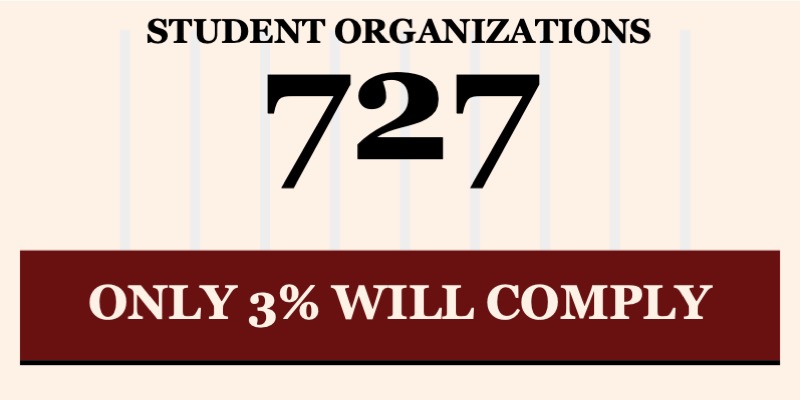
Only 3% of 727 student organizations are fully compliant with new mandatory trainings. At this pace, most organizations could face consequences next spring.
America's graduate funding mess is a national security risk
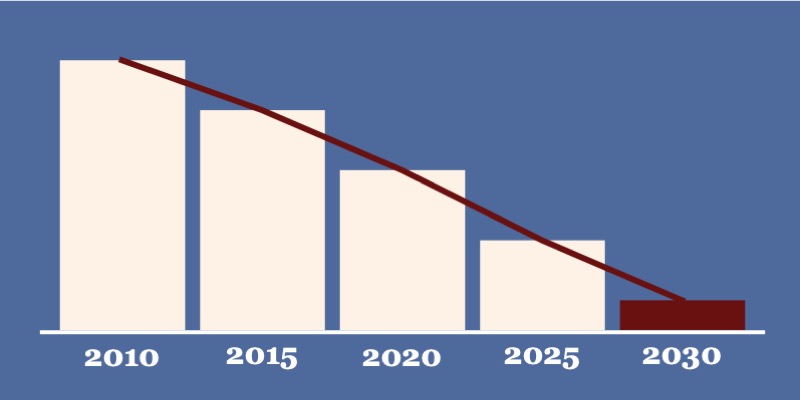
The Trump administration has targeted over 4,000 grants for termination to more than 600 universities, targeting between $6.9 and $8.2 billion in funding.